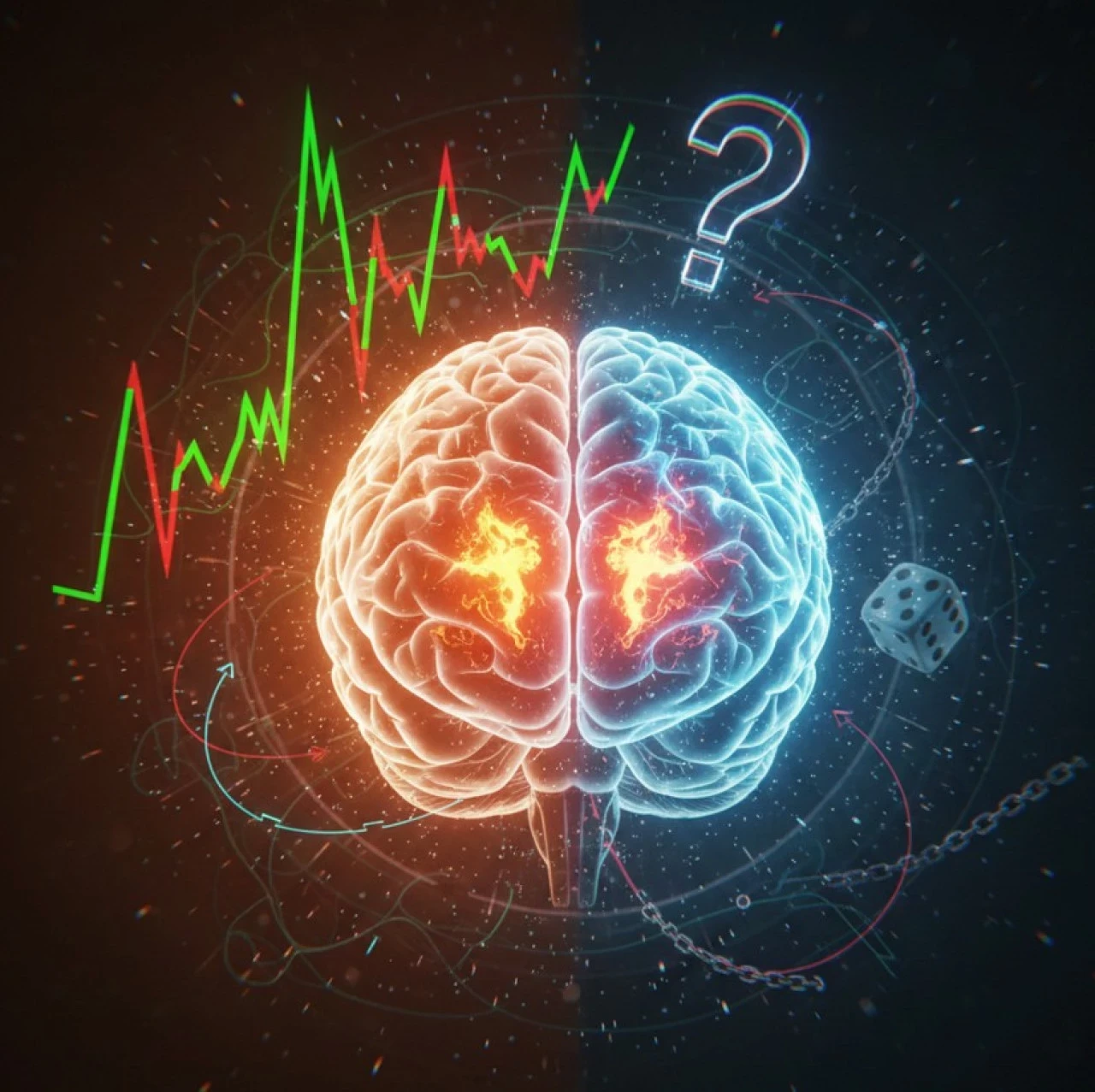
Humans, by nature, seek comfort, predictability, and safety. Yet, throughout history, from early exploration to modern financial markets, we have repeatedly shown an intense attraction to risk and uncertainty. This paradoxical behaviour is not a sign of irrationality, but rather a deeply wired psychological mechanism. Understanding why we embrace the unknown reveals much about decision-making, motivation, and the very core of human nature.
The Neurobiology Behind the Thrill
The immediate and profound attraction to uncertainty can often be traced back to our brain's internal reward system. When faced with a risky but potentially rewarding situation, the brain releases powerful neurochemicals that reinforce the behaviour.
Dopamine: The Anticipation Chemical
The primary driver of risk-taking is dopamine. Often mistakenly called the "pleasure chemical," dopamine is more accurately the "anticipation chemical." Its release spikes not when a reward is received, but in the moments leading up to it. This surge of anticipation creates a powerful, almost addictive, sensation of excitement. Whether we are waiting for an investment return or the outcome of a competition, the uncertainty itself primes the brain for a dopamine hit, making the risk inherently rewarding, regardless of the final outcome.
The Activation of the Nucleus Accumbens
Risk-taking behaviours activate the nucleus accumbens, a key structure in the brain’s reward circuit. This activation system reinforces the actions that led to the reward, or even just the possibility of one. For some individuals, the neural response to the *potential* gain is significantly stronger than the response to an equivalent certain gain, driving them towards higher-risk scenarios.
Cognitive Biases That Fuel Risk
Beyond neurobiology, our attraction to uncertainty is heavily influenced by cognitive shortcuts and errors in judgement. These biases allow us to mentally reframe high-risk situations as more favourable than they truly are.
The Illusion of Control
A prevalent bias is the "Illusion of Control," the tendency to overestimate one's ability to control outcomes that are objectively random. People often believe that their skill, strategy, or unique knowledge can influence the result of a chance event. This self-perception of influence reduces the perceived risk and encourages greater engagement with uncertainty.
Optimism Bias and Underestimation of Loss
Most humans exhibit an optimism bias, believing that negative events (like financial loss or failure) are less likely to happen to them than to others. Simultaneously, we often downplay the magnitude of potential losses. This combination allows individuals to focus disproportionately on the large, attractive potential gain while mentally minimizing the potential cost of failure, creating a psychological justification for taking the risk.
The Motivational Factor: Seeking Mastery and Growth
Not all risk-taking is driven by a simple pursuit of thrills or financial gain. Many forms of uncertainty are sought out because they fulfill fundamental human needs for competence and personal growth.
The Challenge and Competence Need
Psychologically, humans are motivated by a need for mastery. Uncertainty provides a challenging environment where competence can be demonstrated and refined. Taking an calculated risk, whether in a business venture or a complex physical activity, offers the reward of feeling skilled and capable upon success. The greater the initial uncertainty, the greater the sense of achievement when the challenge is overcome.
The deep-seated human attraction to uncertainty is most visibly expressed in regulated entertainment industries that involve chance and potential reward. These platforms—from digital games to specialized betting—leverage our inherent optimism bias and dopamine-driven anticipation to offer experiences that satisfy the innate human need for calculated risk and thrill.
Risk as a Means of Self-Discovery
Engaging with uncertainty can also be a vital path toward self-discovery. By pushing past perceived limitations, individuals learn about their own resilience, tolerance for stress, and true limits. This form of exploratory risk, often seen in travel, career changes, or ambitious projects, is fundamentally linked to personal development and self-actualization.
The Role of Loss Aversion in Shaping Behaviour
While we are drawn to uncertainty, our relationship with risk is complicated by "Loss Aversion"—the principle that the pain of a loss is psychologically twice as powerful as the pleasure of an equivalent gain. This tension often dictates *when* and *how* we choose to take risks.
In short, the human attraction to uncertainty is a complex interplay of biology, cognition, and motivation. We are hardwired to chase the dopamine rush of anticipation, yet we employ cognitive biases to manage the fear of loss. Ultimately, embracing uncertainty is not just about gaining a reward; it is often a fundamental method for growth, self-discovery, and experiencing the intensity of life.
The American Psychological Association (APA), a leading non-profit scientific and professional organization, confirms that risk-taking is deeply rooted in psychological mechanisms, often driven by the brain's reward system. Their research on cognitive science provides authoritative insights into the biases that shape human decision-making under uncertainty.
Frequently Asked Questions (FAQ)
1. What is the primary neurochemical driver of risk-taking behaviour?
The primary neurochemical driver is **Dopamine**. It is often referred to as the "anticipation chemical" because its release spikes in the moments leading up to a potential reward, creating a strong feeling of excitement and reinforcing the desire to engage in uncertain activities.
2. What is the "Illusion of Control" bias?
The Illusion of Control is a cognitive bias where an individual overestimates their ability to influence or control outcomes that are fundamentally random or based on chance. This bias reduces the perceived risk, making people more willing to participate in high-risk scenarios.
3. How does the Nucleus Accumbens relate to uncertainty?
The Nucleus Accumbens is a crucial part of the brain’s reward circuit. When facing an uncertain situation with a potential large payoff, this area is activated, causing a reinforcing effect that motivates the individual to pursue the risk again, regardless of whether the specific outcome is a win or a loss.
4. Why is risk-taking sometimes linked to personal growth?
Risk-taking is often linked to personal growth because it satisfies the fundamental human need for mastery and competence. Overcoming a challenging, uncertain situation (such as a career change or an ambitious project) provides a profound sense of achievement, resilience, and self-discovery.
5. What is the difference between Loss Aversion and the pursuit of risk?
Loss Aversion states that the psychological pain of a loss is roughly twice as impactful as the pleasure of an equivalent gain. While the pursuit of risk is driven by the anticipation of reward (dopamine), Loss Aversion acts as a powerful brake, shaping *when* and *how* people decide to take a chance, often leading them to avoid high-probability losses.